Public sector organizations do not necessarily need larger security teams to improve cybersecurity. Lean state, local, and education IT teams can extend their capacity by combining 24/7 managed monitoring, automated investigation and response, continuous vulnerability management, and access to specialized security expertise. The goal is to reduce the amount of repetitive security work handled internally while keeping governance, risk decisions, and mission-critical context with the agency.
State, local, and education agencies often manage complex technology environments with limited cybersecurity headcount. A small team may support public safety systems, citizen services, employee accounts, operational technology, remote locations, cloud applications, and aging infrastructure at the same time.
More tools do not necessarily solve this SLED cybersecurity staffing problem. Every disconnected console can add alerts, maintenance, reporting work, and vendor coordination. Lean IT security teams need consolidated visibility and clear actions rather than another stream of unprioritized data.
This guide explains how public sector leaders can evaluate monitoring models, extend their existing teams, and direct limited staff toward the risks that matter most.
Best Cybersecurity Monitoring Solutions for Lean Public Sector IT Teams
The best cybersecurity monitoring solutions for lean IT teams combine broad telemetry, automated investigation, prioritized alerts, and analyst-backed response in one operating model.
An effective solution should perform more than alert aggregation. It should correlate activity across security layers, add identity and business context, distinguish urgent threats from background noise, and trigger appropriate response workflows. Without those capabilities, a lean team still has to investigate each alert manually and move between separate tools.
Public sector buyers should evaluate monitoring solutions against five practical requirements:
- Continuous coverage: Confirm who watches the environment outside normal business hours and what happens when an urgent event appears.
- Cross-environment visibility: Require coverage across endpoints, networks, cloud services, applications, identities, and external exposures.
- Actionable prioritization: Ask the provider to demonstrate how it ranks incidents by exploitability, affected identity, asset importance, and potential impact.
- Response authority: Document which actions can be automated, which require approval, and who owns containment.
- Human support: Establish how quickly internal staff can reach a security analyst during an investigation.
AgileBlue combines AI-native detection, investigation, and response with a U.S.-based team of cyber experts. This model gives lean public sector teams continuous operational support without forcing them to recruit, train, and retain enough analysts to cover every shift internally.
How Do CIOs Improve Cybersecurity Without Hiring More Analysts?
CIOs can improve cybersecurity without hiring more analysts by reducing repetitive work, consolidating fragmented capabilities, and assigning specialized operations to a managed security partner.
The priority should be removing low-value manual tasks. Analysts should not spend hours gathering basic context from several consoles before deciding whether an alert matters. A unified platform can correlate endpoint, network, cloud, application, and identity signals before presenting the incident.
Next, establish response rules for recurring events. For example, a workflow may isolate a compromised endpoint, disable a suspicious account, or block malicious infrastructure after defined conditions are met. Agencies should document each workflow’s trigger, approval requirement, rollback procedure, and responsible owner before activation.
CIOs should also measure workload rather than counting alerts alone. Useful operational metrics include mean time to acknowledge, mean time to contain, repeat incidents, unresolved critical vulnerabilities, unsupported assets, and analyst hours spent on manual investigation.
Strategic expertise can fill leadership gaps as well as operational ones. The Strategic Advisory Group conducts security maturity assessments, tabletop exercises, roadmap development, and ongoing reviews. This gives public sector leaders access to experienced security guidance without adding a full-time executive or specialist for every discipline.
SLED Cybersecurity Staffing Priorities
SLED cybersecurity staffing should prioritize decision-making, institutional knowledge, governance, and service continuity while assigning continuous monitoring and repetitive analysis to technology and trusted specialists.
Internal teams possess context an outside provider cannot fully replace. They know which systems support emergency response, transportation, classrooms, benefits administration, public records, and other essential functions. That knowledge should guide incident severity, remediation timing, and recovery decisions.
A practical division of responsibilities assigns internal personnel to:
- Define critical services and data.
- Approve risk acceptance and major containment actions.
- Coordinate agency leadership, legal counsel, communications, and service owners.
- Manage technology policy and procurement.
- Validate recovery priorities and business continuity requirements.
A managed provider can take responsibility for continuous telemetry analysis, threat correlation, initial investigation, escalation, repetitive response actions, and recurring reporting. Roles should be recorded in an incident responsibility matrix, not left to assumptions in a contract.
Public Sector Cybersecurity Monitoring Models
Public sector cybersecurity monitoring models differ in staffing burden, response capability, and operational complexity. A unified AI-native SecOps model combines platform automation with analyst support, offering broader operational coverage than a tool-only deployment and less internal overhead than a fully in-house SOC.
| Monitoring Model | Internal Staffing Burden | Typical Strength | Common Limitation | Best Fit |
| Fully in-house SOC | High | Direct control and institutional knowledge | Recruiting, shift coverage, training, and technology costs | Large organizations with mature security departments |
| Tool-only platform | Medium to high | Internal flexibility | Staff must tune, investigate, and respond to alerts | Teams with established analysts and defined workflows |
| Traditional MSSP or MDR | Medium | External monitoring and escalation | Visibility and remediation depth vary by provider | Organizations needing supplemental coverage |
| Unified AI-native SecOps + managed security operations | Lower | Correlation, automation, managed monitoring, and response | Requires clear governance and integration planning | Lean teams seeking broad coverage without SOC expansion |
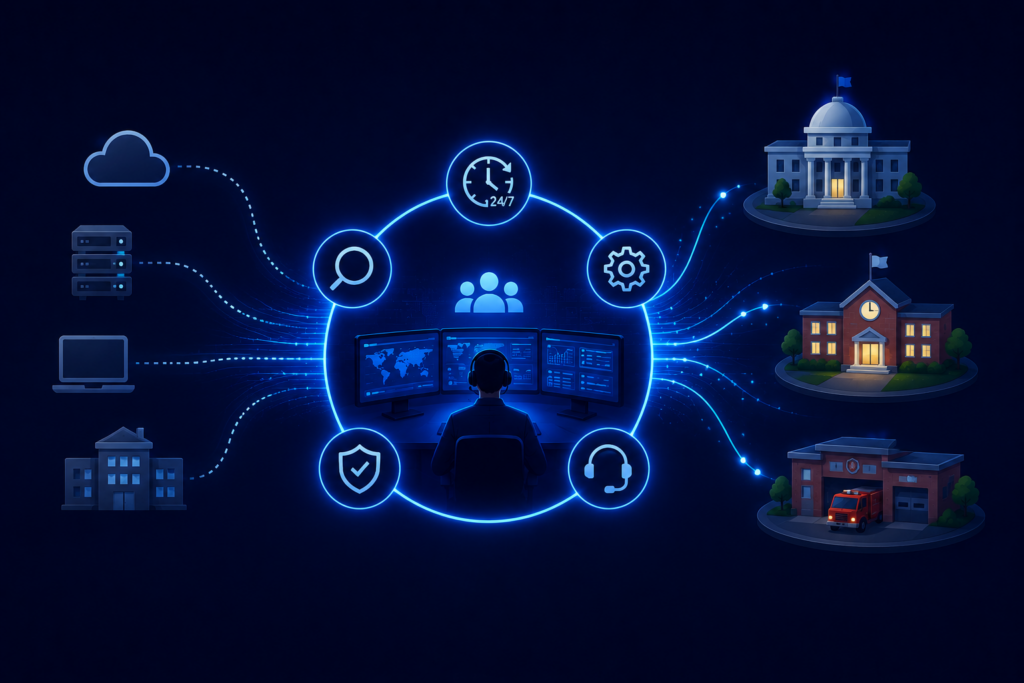
Where AgileBlue fits in: AgileBlue combines a unified AI-native SecOps platform with 24/7 U.S.-based security operations, giving lean public sector teams technology, automation, and human expertise through a single operating model.
A low staffing burden should not mean low accountability. Before selecting a model, require written answers about log ownership, data retention, escalation paths, after-hours response, containment authority, reporting, and transition support.
Ask each provider to walk through a realistic incident from initial signal to closure. Record which party performs triage, enriches the alert, contacts the agency, contains the threat, preserves evidence, and tracks remediation. A vague answer at any stage usually points to work that will fall back on the internal team.
Vulnerability Management for Lean IT Security Teams
Vulnerability management for lean IT security teams should continuously discover assets, prioritize exploitable weaknesses, and provide clear remediation paths.
Periodic scans can leave long gaps between discovery and remediation. Continuous scanning provides a current view of devices and vulnerabilities while dynamic asset discovery identifies changes in the environment. Real-time notifications can alert the team when a new device appears or when a new weakness affects an existing asset.
The platform also segments devices for clearer oversight across multiple networks. Low network utilization allows scanning to run behind the scenes, including across Layer 3 tunneling protocol connections, without physical appliances.
Lean teams should use a risk-based remediation sequence:
1. Address vulnerabilities with known active exploitation on internet-facing systems.
2. Prioritize weaknesses affecting privileged identities or mission-critical services.
3. Set shorter remediation windows for critical and high-risk findings.
4. Record temporary mitigations when immediate patching could disrupt essential operations.
5. Rescan remediated assets and retain evidence for audits.
At scale, reducing investigation time for each weakness gives limited staff more capacity for patch coordination and control validation.
External Threat and Identity Monitoring
External threat and identity monitoring identifies risks that begin beyond the agency’s managed network, including exposed credentials, leaked data, malicious domains, and third-party exposure.
Modern attacks often begin with information that traditional endpoint tools cannot see. Compromised credentials may appear in stealer logs or cybercrime marketplaces before an account is abused. An impersonation domain may target citizens or employees without touching agency infrastructure during its setup.
Continuous external visibility can cover:
- Exposed credentials and compromised identities
- Dark web sources and cybercrime marketplaces
- Leaked data and stealer logs
- Brand impersonation and malicious domains
- Third-party and supply chain exposure
- External attack surface risk
Lean teams should connect external exposure findings directly to response playbooks. A confirmed credential exposure should trigger identity validation, password reset, session revocation, and multifactor authentication review. A malicious look-alike domain should trigger evidence capture, takedown procedures, and communication with affected departments.
This intelligence should flow into existing security operations rather than a siloed dashboard. AI-driven prioritization can connect an external exposure to the affected user, access level, and internal assets, giving analysts the context needed to act quickly.
Cybersecurity Automation Guardrails for Public Agencies
Cybersecurity automation guardrails define which actions technology may take, under what conditions, and with whose approval. Not every response should be fully autonomous. Blocking known malicious infrastructure may carry little operational risk, while isolating a device that supports public safety or transportation could interrupt essential services. The difference belongs in a documented response policy.
A strong automation policy separates actions into three groups. Low-risk actions may run automatically, such as enriching an indicator or opening a case. Moderate-risk actions may require analyst validation, such as disabling a standard user account. High-impact actions, such as isolating a critical server, should require approval from a named agency owner unless an emergency threshold applies.
Run tabletop exercises against these policies at least annually and after major architecture or leadership changes. Test a compromised administrator account, ransomware on a critical system, and a third-party outage. Record decision points, unavailable evidence, unclear authority, and communication delays.
Why AgileBlue for Public Sector Cybersecurity Staffing Challenges
AgileBlue is built for organizations that need stronger security operations without building a larger SOC. The platform brings detection, investigation, response, vulnerability management, external threat intelligence, and security visibility into one operating model, backed by a 24/7 U.S.-based team of cyber experts.
Instead of sending another stream of alerts to an already stretched IT team, AgileBlue investigates security activity, adds context, prioritizes what matters, and supports response. Internal teams retain control over critical business and risk decisions while AgileBlue handles much of the continuous monitoring and repetitive operational work.
For organizations that also lack dedicated security leadership, AgileBlue’s Strategic Advisory Group extends the model beyond day-to-day operations with security assessments, tabletop exercises, roadmap development, and ongoing strategic guidance.
Strengthen Your Lean Public Sector Security Team
We can assess your current monitoring model, identify staffing pressure points, and map a practical path toward continuous coverage. Talk with our team about consolidating security operations, automating repeatable response work, and adding strategic guidance without building a larger internal SOC.
Get a demo focused on your agency’s systems, compliance obligations, and service continuity priorities.
FAQ
Q: Should we outsource our entire public sector security program?
A: Most agencies should retain governance, risk acceptance, service context, and executive accountability internally. Continuous monitoring, alert triage, vulnerability scanning, threat intelligence, and specialized advisory work can be assigned to a provider. A responsibility matrix should document ownership for every stage of detection, containment, recovery, and reporting.
Q: How can we reduce cybersecurity alert fatigue with a small team?
A: Reduce alert fatigue by correlating signals across tools, suppressing confirmed benign activity, ranking incidents by asset and identity risk, and automating repeatable enrichment. Review recurring alerts monthly. If an alert never changes a decision or triggers a response, retune it, combine it with related signals, or retire it.
Q: What cybersecurity metrics should a SLED CIO report to leadership?
A: Report metrics tied to operational and public-service risk. Useful measures include critical vulnerabilities past deadline, mean time to acknowledge and contain incidents, coverage of critical assets, multifactor authentication adoption, repeat incidents, recovery test results, and unresolved risks affecting essential services.
Q: Is managed detection and response the same as a managed SOC?
A: The terms overlap, but service scope varies. Managed detection and response usually focuses on monitoring, investigation, and response across defined technologies. A managed SOC may include broader log management, SIEM operations, reporting, threat intelligence, vulnerability context, and compliance support. Buyers should compare written responsibilities rather than service labels.
Q: How often should a public agency run a cybersecurity tabletop exercise?
A: Public agencies should conduct a tabletop exercise at least annually and after major changes to systems, leadership, vendors, or response plans. Higher-risk organizations may test focused scenarios more often. Each exercise should produce assigned corrective actions, deadlines, and a follow-up review rather than ending with an observations report.