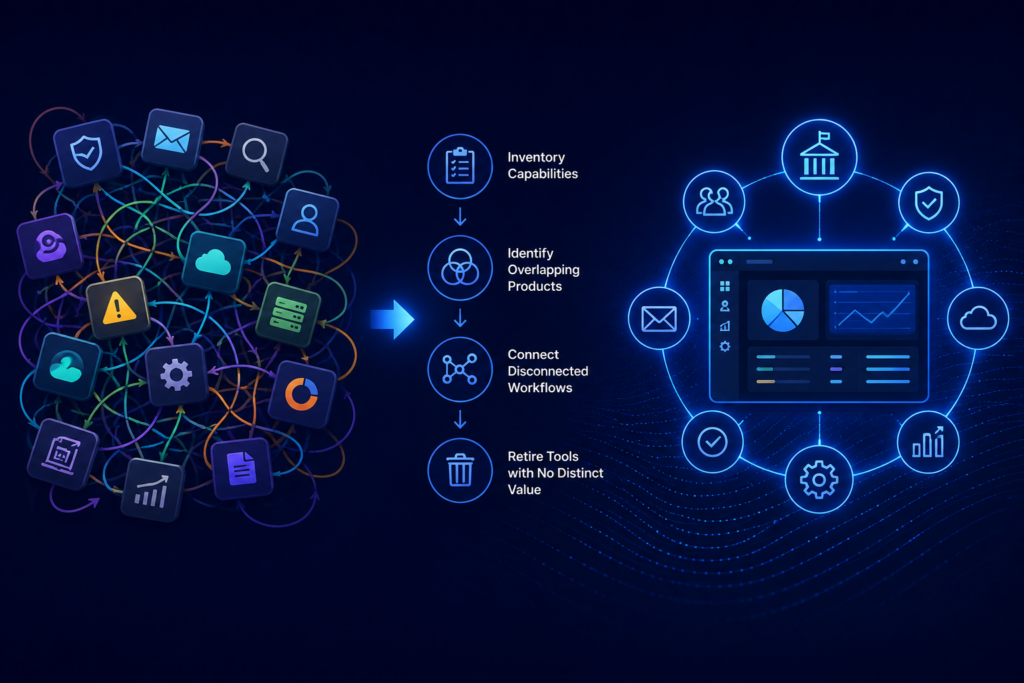
SLED organizations can reduce cybersecurity tool sprawl by inventorying capabilities, identifying overlapping products, connecting disconnected workflows, and retiring tools that no longer provide distinct value. Effective consolidation should reduce cost and administrative work without sacrificing telemetry, response coverage, resilience, or compliance support.
The goal is not to force every security function into one product. It is to establish a practical operating model in which each retained technology has a clear purpose, owner, integration path, and measurable outcome.
How Can State, Local and Educational Organizations’ IT Teams Consolidate Cybersecurity Tools and Reduce Tool Sprawl?
State, local and educational organizations’ IT teams can consolidate cybersecurity tools through a capability-led process rather than replacing products one at a time. Start by mapping every product to the security outcome it supports, its data sources, operating costs, owner, contract date, and measurable value.
Build an inventory that includes paid products, free utilities, inherited systems, managed services, cloud-native controls, and tools operated by outside providers. For each one, record whether it supports prevention, visibility, detection, investigation, response, vulnerability management, compliance, or reporting.
Next, identify duplicate capabilities and disconnected workflows. Two products may appear different while generating the same endpoint alerts. A vulnerability scanner has limited value when its findings never reach the people responsible for remediation. Consolidation should connect telemetry, analysis, response, and reporting rather than merely reduce vendor contracts.
Apply three practical rules during the assessment:
- Retire products that duplicate a stronger capability and provide no unique telemetry.
- Integrate valuable controls when replacement would introduce unnecessary operational risk.
- Replace disconnected tools when analysts must repeatedly transfer alerts, evidence, or remediation tasks by hand.
What Causes SLED Cybersecurity Tool Sprawl?
SLED cybersecurity tool sprawl develops when agencies acquire products for isolated requirements without a shared architecture or retirement plan. Grants, departmental purchasing, emergency procurements, inherited infrastructure, compliance mandates, and limited staffing can all add technology faster than teams can integrate it.
The resulting stack often includes several products that collect similar data but apply different scoring systems. Analysts may monitor separate consoles for endpoints, networks, cloud systems, email, identities, and vulnerabilities. Important context gets lost between those interfaces, and high-priority alerts compete with duplicate or low-value notifications.
Tool sprawl also creates expenses beyond licensing. Agencies must account for implementation, training, integrations, maintenance, storage, professional services, and employee time. A low-cost point product can become expensive when a scarce security specialist must manage it manually.
Agencies should review the stack before every major renewal, not only after a security incident. Start the review at least 120 days before contract expiration so procurement, legal, operational testing, and migration have adequate time.
What Should a SLED Security Stack Consolidation Plan Include?
A SLED security stack consolidation plan should include an asset inventory, capability map, target architecture, financial baseline, migration sequence, and measurable exit criteria. We use these elements to connect purchasing decisions to operational security outcomes.
Establish the Current-State Baseline
Record the analyst hours required each month for administration and alert handling. This exposes hidden labor costs that licensing reports miss.
Agencies should also locate unmanaged assets and shadow technology. Dynamic asset discovery can find devices that purchasing records or configuration databases overlook. Our vulnerability scanning can run through device agents or a network sensor, supporting visibility across multiple networks with low network utilization.
Define the Target Security Architecture
The target architecture should state which platform becomes the system of record for alerts, investigations, response actions, vulnerabilities, and executive reporting. It should also distinguish controls that will be retained, integrated, replaced, or retired.
Require each retained tool to meet at least one of these tests: it provides unique telemetry, controls a material risk, satisfies a documented requirement, or performs a function the core platform cannot deliver. Products that fail all four tests are strong retirement candidates.
Set Exit Criteria Before Migration
Do not decommission a product because its replacement has been purchased. Retire it only after validating telemetry coverage, alert routing, response workflows, data retention, reporting, and staff access.
Run old and new capabilities in parallel for a defined validation period. A 30-day window may cover routine operations, while environments with infrequent workflows may require 60 to 90 days. Record missing logs and workflow failures before terminating the legacy contract.
Security Stack Consolidation Options for SLED Agencies
SLED agencies generally choose among point-product rationalization, platform consolidation, and a managed AI-native model. We support the third approach, combining broad platform coverage with round-the-clock security operations and strategic guidance.
| Approach | Operating Model | Primary Advantage | Main Limitation | Best Fit |
|---|---|---|---|---|
| Point-product rationalization | Retain several specialized products while removing direct duplicates | Preserves valuable investments and unique capabilities | Multiple consoles, integrations, and workflows may remain | Organizations with specialized internal expertise |
| Platform consolidation | Move several security capabilities into one primary technology platform | Reduces contracts, interfaces, and administrative complexity | Internal staff still own tuning, investigation, and response | Organizations with sufficient internal SOC capacity |
| AI-native managed platform (AgileBlue) | Combines integrated technology, automation, 24/7 response, and advisory support | Reduces operational burden and fragmented workflows | Requires clear shared-responsibility planning | Lean SLED teams needing broad coverage |
Point-product rationalization can reduce licenses without resolving workflow fragmentation. Platform consolidation goes further, but the agency may still need staff to tune rules, investigate alerts, manage incidents, and prepare reports.
The correct model depends on existing staff, regulatory obligations, procurement constraints, and operational maturity. Count the work that remains after implementation, not just the capabilities listed in a proposal.
How Can Agencies Consolidate Tools Without Creating Security Gaps?
Agencies can consolidate tools without creating security gaps by migrating in phases, validating data coverage, and maintaining rollback options until replacement controls pass operational tests. We recommend grouping migrations by capability and risk instead of attempting a single cutover.
Start with telemetry and asset discovery. Confirm that endpoints, network segments, cloud environments, applications, identities, and externally exposed assets appear in the new platform. Compare asset counts against procurement records, directory services, cloud inventories, and network scans.
Next, validate detection and response. Test representative events in a controlled setting, then confirm that alerts include the expected context and reach the correct responders. A detection is incomplete when it appears in a console but never creates an assigned action.
Vulnerability management requires its own test. Our integrated scanning provides continuous monitoring, real-time notifications for new devices and vulnerabilities, dynamic asset discovery, and remediation pathways. The system can segment devices across multiple networks and supports NIST data gathering and CIS Controls 1 and 7 activities.
Finally, test governance. Confirm role-based access, evidence retention, executive reports, incident escalation, and after-hours contacts before decommissioning legacy tools. Tabletop exercises can expose unclear responsibilities without waiting for a real incident.
What Metrics Show That Security Stack Consolidation Is Working?
Effective security stack consolidation produces measurable improvements in cost, coverage, response speed, and staff workload. We recommend establishing baseline values before migration and reviewing the same metrics after each consolidation phase.
Useful operational metrics include the percentage of known assets sending telemetry, duplicate alerts per incident, mean time to acknowledge, mean time to contain, unresolved critical vulnerabilities, and analyst hours spent on manual triage. Financial metrics should include total annual contract cost, integration spending, storage charges, and administrative labor.
Specific indicators to track:
- Percentage of critical assets monitored continuously
- Number of security products and vendor contracts retired
- Percentage of alerts enriched with asset and identity context
- Critical vulnerabilities remediated within the agency’s approved service target
- Number of manual handoffs required per incident
- Time required to prepare audit or leadership reports
Public agencies should set targets based on their current baseline rather than borrowing another organization’s score. The strongest measurement program connects platform activity to reduced exposure and faster action.
Why AgileBlue for SLED Cybersecurity Tool Sprawl?
AgileBlue helps SLED organizations consolidate security operations across detection, investigation, customer-authorized response, centralized security data, endpoint visibility, vulnerability management, and threat exposure management. Sapphire AI and AgileBlue’s 24/7 U.S.-based SOC reduce manual investigation and handoffs, while integrations allow organizations to retain specialized technologies that continue to serve a documented purpose.
The objective is not to replace every existing control. It is to create a more unified operating environment with clearer ownership, fewer duplicate capabilities, and less work placed on the internal team.
Strategic Advisory adds security maturity assessments, tabletop exercises, ongoing reviews, and actionable security roadmaps. When DFIR or penetration testing is required, we coordinate with trusted partners and incorporate the findings into the long-term program.
Build Your SLED Security Consolidation Roadmap
We can assess your current products, identify overlapping capabilities, and define a phased target architecture around your agency’s risk and staffing needs. Talk with our team about consolidating detection, response, vulnerability management, and reporting without sacrificing essential coverage. We will translate the assessment into practical migration priorities and measurable retirement criteria. Request a demo.
FAQ
Q: How many cybersecurity tools are too many for a government IT team?
Q: Should we wait until contract renewal to replace an overlapping security product?
A: When procurement timelines permit, begin the assessment approximately 120 days before renewal so the organization has time to evaluate alternatives, complete legal and procurement reviews, and validate replacement capabilities. Early planning gives the agency time to test coverage, export required records, train staff, and negotiate terms without being forced into an automatic renewal.
Q: Can we consolidate security tools if different departments control their own technology?
A: Yes. Establish shared security outcomes and minimum telemetry requirements while allowing departments to retain justified specialized controls. A central platform can aggregate alerts and coordinate response without requiring every department to use identical business systems.
Q: Will consolidation create a single point of failure?
A: Consolidation can concentrate operational dependency, so agencies should evaluate platform availability, data portability, access controls, incident procedures, and rollback plans. The goal is fewer disconnected workflows, not blind dependence on one component. Retain independent controls where they address a documented resilience requirement.
Q: What should be included in a cybersecurity tool inventory?
A: Include the product name, owner, annual cost, contract term, supported assets, data sources, integrations, retention settings, users, compliance purpose, and monthly administration effort. Also document free tools, cloud-native controls, inherited systems, and products managed by outside providers.
Q: How long does a security stack consolidation project take?
A: Timing depends on contract cycles, integrations, environment size, and procurement requirements. A phased project commonly begins with several weeks of discovery, followed by migration waves with 30 to 90 days of parallel validation for each major capability.